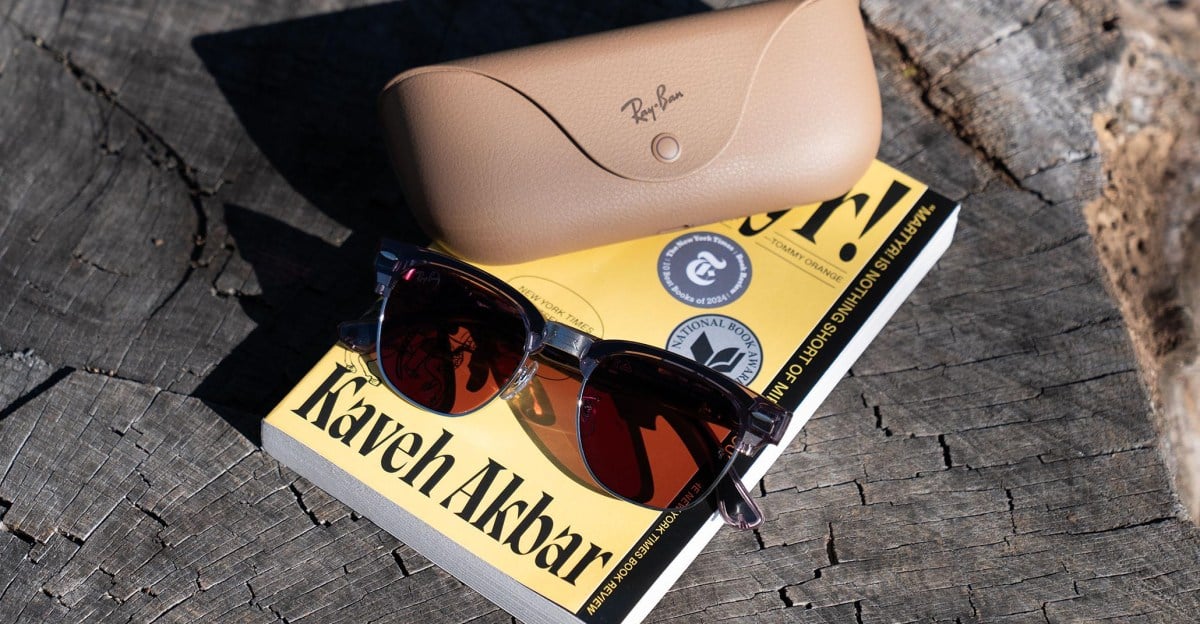
Ray-Ban Meta Audio, Meta’s first camera-free AI glasses, went on sale this week starting at $349, rising to $429 for some frames. Weighing just 43 grams, the Clubmaster and Burbank styles trade the camera for a battery rated at up to 12 hours per charge, with Meta pitching them as glasses built around audio.
Camera-equipped Ray-Ban Metas weigh 51 to 55 grams, according to ZDNET; the new audio pair comes in at 43 to 47 grams, against around 30 grams for regular glasses. The price is the first thing reviewers argue about. ZDNET, by contrast, framed the new pair as cheaper than the camera-equipped model at the $349 entry point. The two outlets compare against different models, so the gap depends on which one a buyer has in mind.
$349 to $429 Buys 43 Grams and a 12-Hour Battery
Meta’s own announcement lists 23 frame and lens combinations, all available with prescription lenses, and sales through Meta.com, Ray-Ban.com, Ray-Ban stores, Meta Lab stores and EssilorLuxottica retail locations. The company says the glasses deliver up to 12 hours on a charge or 6 hours of continuous audio, plus up to 48 more hours from the included case. A 22-minute case charge reaches 50 percent.
Mashable’s buying guide adds that the glasses support prescriptions from −12.00 to +6.00, a six-microphone array, and real-time translation across 20 languages. ZDNET cites 60 hours with the case, up from nine hours of rated endurance on the camera model. CNET puts the weight at 43 to 47 grams, against a little over 50 grams for other Meta Ray-Bans.
PCMag’s review breaks down the pricing by frame. The Clubmaster comes in preconfigured styles: $349 for black frames with clear or standard tint, $379 for transparent gray, and $429 for Transitions lenses.
PCMag also lists dimensions. The standard Burbank is 5.67 inches wide and 1.5 inches tall, weighing 1.52 ounces, while the large Burbank is 5.91 inches wide, 1.57 inches tall and 1.59 ounces. The Clubmaster comes in one size, 5.67 inches wide and 1.73 inches tall, at 1.66 ounces. The standard Ray-Ban Meta Wayfarer weighs 1.82 ounces, almost a third of an ounce more than the Burbank.

ZDNET’s reviewer put the weights at 43 grams for the Burbank and 47 for the Clubmaster, still above regular glasses at around 30 grams but well below camera-equipped Ray-Ban Metas at 51 to 55 grams. PCMag’s reviewer found the standard Burbank a bit small and slightly snug, but lightweight and comfortable otherwise.
Controls are the same on both styles. A power switch sits behind the right hinge, with a customizable action button above it that summons Meta AI by default. A touch surface behind the Ray-Ban logo handles taps and swipes for calls and playback. Thin metallic accents sit where the camera and indicator LED appear on standard Ray-Ban Meta glasses.
Meta Drops the Camera to Ease Privacy Worries
Privacy is the stated driver. PCMag’s reviewer wrote that camera glasses have become divisive amid reports of people using models like the Ray-Ban Meta to stalk and harass, and judged that removing the lens eliminates the social stigma. A Vocal report on the Connect 2026 unveiling said the model responds to criticism that had earlier models labeled pervert glasses
. Vocal also reported Meta launched a third-generation camera model alongside it, with a 12 MP sensor and up to nine hours of battery.
Reviewers say the social effect is real. ZDNET’s reviewer described side-eye in public while wearing camera glasses, and after a week with the audio pair concluded they are a safer entry for people wanting to avoid the creep factor
. Tom’s Guide’s tester wore them to a son’s soccer game and said removing the camera ended worry about other parents wondering whether children were being filmed.
Your favorite Ray-Ban styles now have a soundtrack.Introducing Ray-Ban Meta Audio glasses. Built-in audio.Up to 12 hours of battery life.Refined for all-day comfort.Customizable controls.Available October 13. Pre-order now.
Losing the Camera Costs Some Users
The Verge’s reviewer was relieved not to fear confrontation but refused to call the privacy problem solved. Some people the author knows would miss the camera for home videos, content creation, accessibility or multimodal AI. The review also questioned whether Meta might add ambient listening later, calling the missing camera a comfort for now
-style rather than permanent; the reviewer’s own words were that it is only a comfort for now.
Accessibility is a sharper split. The Verge noted a camera model is more helpful to low-vision and blind users, that the FDA-cleared hearing assistance feature is not yet available, and that the less powerful Muse Spark model ships now, with Meta’s Muse AI still to come. CNET likewise says it is unclear when fully agentic Muse AI arrives. ZDNET added that Meta AI can add calendar entries but cannot book a reservation the way agentic models can.
The Verge’s reviewer called Muse Spark better than what the Ray-Bans offered in 2023 but still underwhelming outside accessibility use, and said that for those users the glasses may not be the best use of $350. In one test the assistant claimed Google Calendar was not connected when it was.
Reviewers Split on $350 Earbuds With a Frame
Verdicts diverge. PCMag’s headline says the glasses are better without cameras. ZDNET scored them 3.5 out of 5, citing crisp audio and the longest battery in the Ray-Ban Meta line but only passable microphone quality. Yahoo’s reviewer said for most people the answer to whether they justify $349 to $429 is no, noting that AirPods 5 with ANC retail for $129, though calling the sound terrific and the call quality better than many sub-$150 earbuds.
ZDNET’s reviewer said callers often described his voice as sounding cupped, and his wife joked he sounded like a call-in guest on an AM radio show. A hard switch on the inner frame, which also starts pairing, doubles as a microphone mute.
Open-ear design has limits. The Verge’s reviewer said ambient noise can drown out audio even at top volume, so the glasses will not cut it on a loud subway, though they suit audiobooks at home and walks. Yahoo’s reviewer wore them from morning to night for several days, listened to at least four hours daily, and found Meta’s 12-hour estimate on point.

PCMag’s reviewer liked the light brown faux-leather charging case, a hard-sided design with a magnetic peg that doubles as a battery LED. The glasses snap onto a hook inside. The Meta app also works with Apple Music, Apple Health, Spotify, Strava and Audible, among others.
CNET’s Scott Stein called them nicely made but said they do not solve deeper problems, and noted other audio glasses, including Google’s, are on the way in the next year. Tom's Guide's tester, who started unimpressed, found the glasses practical for driving directions while traveling with three children in the car.
Meet the latest Ray-Ban Meta innovations.🕶️ Ray-Ban Meta (Gen 3), available in the iconic Wayfarer & Aviator and Zena for the first time🔥 Exclusive limited-edition of Ray-Ban Meta (Gen 3) Aviator🎧 New Ray-Ban Meta Audio glassesThe next chapter of Ray-Ban Meta starts now. pic.twitter.com/skF5dNVGm4
Stein also suspects the Ray-Ban branding, rather than Meta’s, reflects EssilorLuxottica’s push toward more acceptable smart eyewear, aimed at buyers who want only audio help. The Verge’s reviewer said that at a much lower price the glasses would be a no-brainer, but $350 without prescription lenses, hearing assistance or Muse feels off, though the camera was not missed.
One practical limit: Yahoo’s reviewer stressed the phone must stay connected, since it supplies the internet connection and the Meta AI app handles real-time translation.
The Verge’s author recalled wearing Bose Frames seven years ago, which also paired Bluetooth audio with sunglasses and drew no notice.