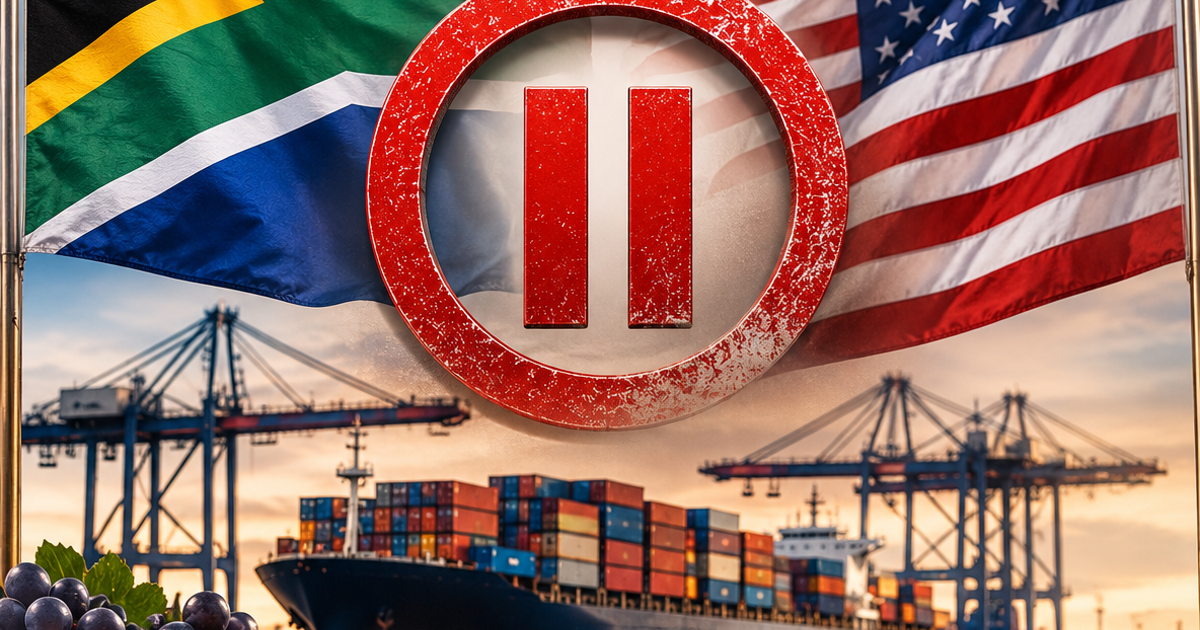
South African exporters will lose duty-free access to the US market on 1 January 2027, after the Trump administration notified Congress on Monday, November 2, 2026, that it intends to remove South Africa and Rwanda from the African Growth and Opportunity Act (AGOA). The goods themselves can still enter the US, but at higher tariffs.
US Trade Representative Jamieson Greer said an annual interagency review found both governments engaging in practices that are inconsistent with AGOA’s eligibility criteria, according to the USTR statement. He pointed to barriers to American trade and investment and to practices that threaten US national security and foreign policy interests.
The statement from Greer’s office described the practices as concerning and pervasive
and said they include, but are not limited to, those barriers. Both governments were also notified directly of the decision. The planned termination would not end ordinary trade between the US and the two countries, but it could make affected exports more expensive by removing preferential tariff treatment.
Different charges for Pretoria and Kigali
The administration’s list for South Africa is shorter than Rwanda’s. For South Africa, it cited trade and investment barriers, corruption, and national security and foreign policy concerns. For Rwanda, it added the rule of law, political pluralism, workers’ rights and human rights.
TRUMP EXTENDS AGOA: SOUTH AFRICA GETS ANOTHER LIFELINE FOR PREFERENTIAL US TRADE The United States has extended the African Growth and Opportunity Act (AGOA), providing continued preferential trade access for eligible African countries, including South Africa. The move comes… pic.twitter.com/Qzc6VW8jvU
The Rwanda decision came barely a week after the US Treasury sanctioned Rwanda’s defence ministry over its alleged role in the rebellion in eastern DR Congo. The Treasury said the ministry directed thousands of troops to fight alongside M23 rebels, supplying weapons, equipment, logistics and training.
Rwandan Foreign Minister Olivier Nduhungirehe told AFP, before the sanctions were imposed, that Rwanda must not be held as a scapegoat for what is happening in Congo forever
.
EWN linked the decision to months of diplomatic friction over land reform and black economic empowerment policies, as well as South Africa’s case against Israel at the International Court of Justice over allegations of genocide in Gaza. The USTR statement itself names none of those.
US Ambassador to South Africa Leo Brent Bozell III wrote on X that the outcome was predictable and preventable
, resulting from Pretoria’s rejection of what he called real US concerns.
Trade Minister Parks Tau had earlier said the country hoped for a favourable decision. A little over a week before the announcement, President Ramaphosa said the country should “prepare” for an adverse decision.
What a 3.4% tariff bump means for exporters
South Africa was AGOA’s largest beneficiary, exporting approximately $1.7 billion worth of goods to the US under the programme in 2025, including vehicles, agricultural products, clothing and manufactured goods. Losing preference does not close the market. Over the programme’s lifetime, South Africa accounted for 54% of AGOA-related exports to the US, and about 22% of its exports to the US benefit from AGOA.
Wandile Sihlobo, the Presidential Envoy on Agriculture, told Food For Mzansi: We will have access, but with slightly higher tariffs.
He estimates an added Most Favoured Nation tariff of about 3.4%. Products now entering at the 12.5% “Liberation Day” rate would face 15.9%.
Sihlobo, who also serves as Agbiz chief economist, argues in a Daily Maverick opinion piece that this is less severe than 2025, when farm exports faced tariffs of around 30% and still totalled $504 million, down 3% on the year. Agricultural exports rose 56% from the first to second quarter of 2026, to $123 million, as tariffs fell from 30% to 12.5%. Roughly 4% of South Africa’s agricultural exports go to the US, among them citrus, berries, grapes, wine, fruit juices, apples, pears and nuts.
Exports were uneven within 2025. Some exporters took advantage of the 90-day pause in the second quarter and shipped more than usual. Exports to the US fell 11% in the third quarter to $144-million, then fell 39% in the fourth quarter to $81-million.
He concedes some sectors will feel it more.
Blame, diversification and the Nedlac contingency talks
Trade union Solidarity blamed President Cyril Ramaphosa and international relations minister Ronald Lamola for South Africa’s exclusion.
On October 29, Trade Minister Parks Tau and Nedlac members discussed measures to cushion businesses and workers, including new markets such as Vietnam, Thailand, South Korea, the Philippines, Saudi Arabia, China and Japan.
Tau also said that regardless of Trump’s decision on AGOA, South Africa’s economy would remain stable as the country seeks other international markets.
A review cycle that is annual, and a 60-day notice
Any removal requires 60 days’ notice to Congress and the country concerned. Greer said the administration wants African partners to take the steps needed to meet the criteria, leaving room for engagement before the termination date.

In 2015, under former US president Barack Obama, South Africa previously risked losing its AGOA benefits, after a dispute over market access for American poultry, pork and beef. By March 2016 the requirements were met and the threat lifted, after negotiations led by then trade and industry minister Rob Davies.