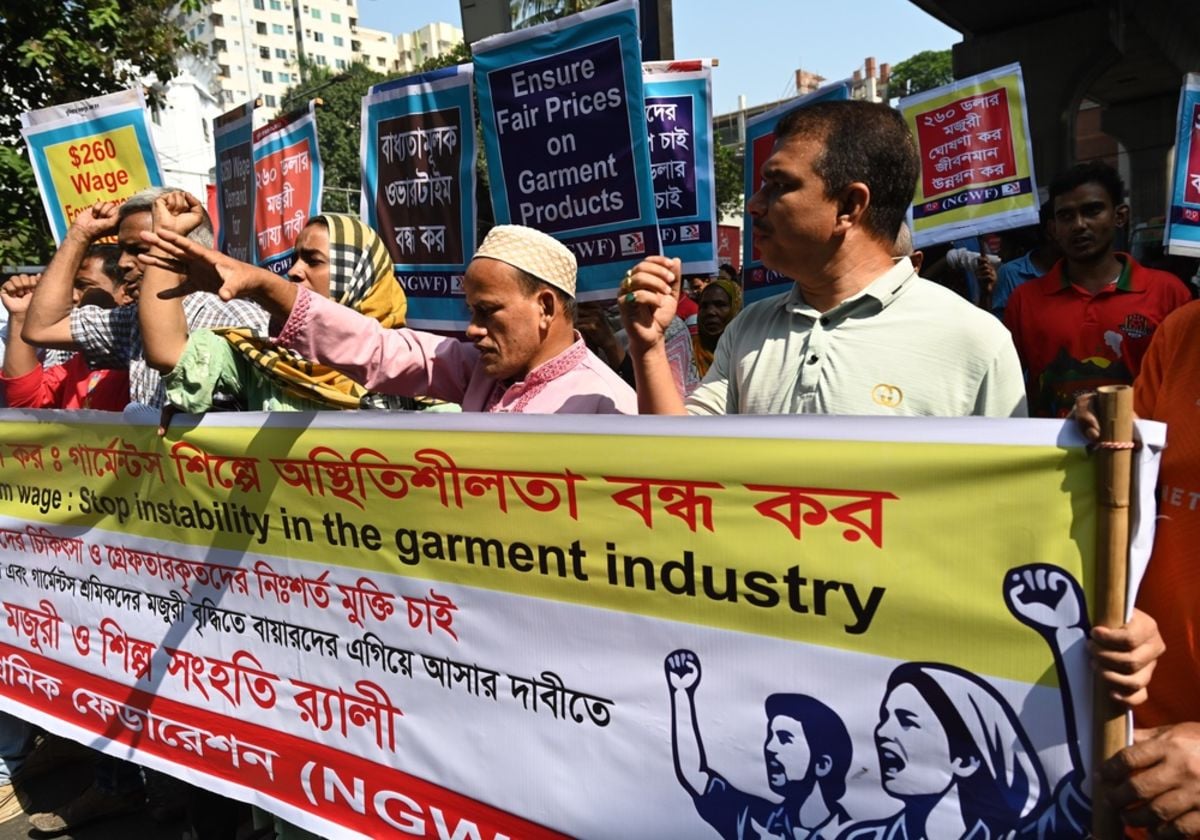
Nearly 150 garment factories in Savar, Ashulia and Gazipur stood shut over the weekend. Bangladesh’s minimum wage board meets on Monday, 16 November, to hear employers’ wage proposal, the BBC reported.
Workers are demanding a minimum wage of 30,000 taka a month, against the current 12,500 taka, which was fixed in December 2023. The industry employs about four million people and generates nearly $40bn in exports a year, according to the BBC.
Owners Tie Talks to Factory Security
On Saturday 14 November, the Bangladesh Garment Manufacturers and Exporters Association (BGMEA) and the Bangladesh Knitwear Manufacturers and Exporters Association (BKMEA) threatened to withdraw from the wage talks. They said protesters were vandalising factories.
“If the situation persists, we must reconsider,” BGMEA President Mahmud Hasan Khan said at a news briefing in Dhaka, The Times of India reported.
Khan also said factories unable to operate would stay closed indefinitely under Bangladesh’s labour law. Section 13(1) of the Bangladesh Labour Act 2006 lets employers suspend operations during unrest. Under the “no work, no pay” provision, workers receive no wages while a factory is shut, The Business Standard reported.
Despite the threat, the BGMEA confirmed it will attend Monday’s meeting to submit its proposal. It said later participation will depend on conditions on the ground, according to The Business Standard and India Today.
The owners’ associations said 147 member factories, employing roughly 300,000 workers, were completely unable to operate, according to Just News BD. Of these, 55 were closed and 92 failed to resume production despite attempts.

Owners said Section 13(1) prevents arbitrary closures. But they said the unsafe environment left them no choice.
The Financial Express reported that BGMEA directors had divided industrial zones, including Savar, Ashulia, Gazipur, Narayanganj and Chattogram. Their aim was to consult owners on the proposal, each speaking to between 10 and 20 entrepreneurs. Several BGMEA leaders said the employers would submit their proposal at Monday’s session.
Factories Close and Clash in Gazipur
At least 147 factories were closed on Saturday, AFP reported. More than 4,500 factories are registered with trade bodies such as the BGMEA.
On Sunday morning, workers blocked the Dhaka-Tangail highway in Gazipur for about an hour before police stepped in, the BBC said. In Konabari, police used tear gas and sound grenades to disperse workers, India Today reported.
Authorities shut 13 Gazipur factories indefinitely, and five others declared a one-day holiday. The Savar-Ashulia belt was largely calm. But more than 50 factories there remained closed, Superintendent Mohammad Mominul Islam Bhuiyan of Industrial Police-1 told The Business Standard. Industrial Police sources said 36 were closed under Section 13(1), 14 indefinitely and five on verbal instructions.
Bhuiyan said workers at five other factories had entered their workplaces but were abstaining from work rather than resuming production. A total of 48 platoons of law enforcement personnel have been deployed across industrial areas in Dhaka, Gazipur and Narayanganj to protect factories, The Business Standard reported.
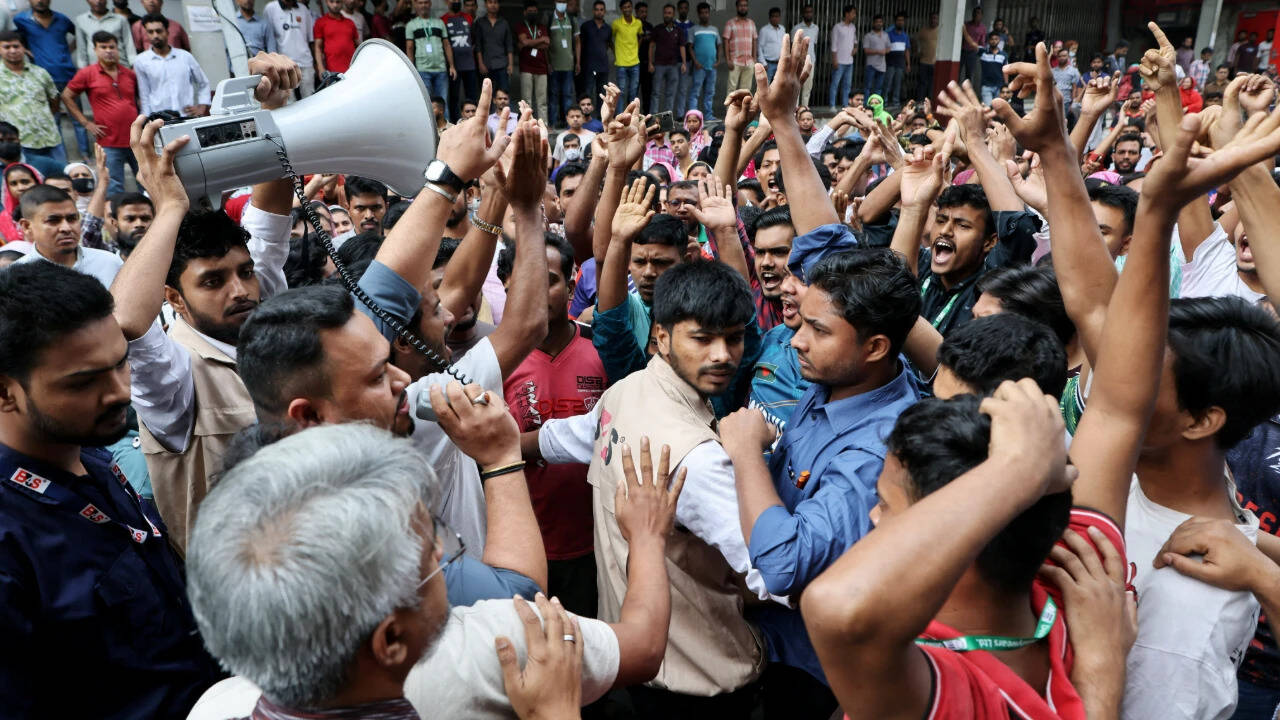
Earlier this month, one worker was killed in Gazipur and police said more than 100 people were arrested, Vogue reported on 9 November. United News of Bangladesh later put arrests at 132 in connection with cases filed over the unrest.
Of those arrested, 72 were held by Savar Police Station and 60 by Ashulia Police Station, the agency said.
Workers and Employers Stand Far Apart
The government formed the board on 1 November, with a senior district judge as chair. It said it would finalise recommendations by the end of November, with a new pay structure expected from 1 December. Workers would receive their first salaries on the new scale in January, India Today said.
The figures differ. The BBC, India Today and AFP cite a 30,000-taka demand. At the board’s 9 November meeting, workers’ representatives proposed 32,000 taka, according to The Times of India. Employers were given four days to prepare a counterproposal.
The workers’ proposal also envisages four wage grades, with monthly salaries from 32,000 to 48,000 taka, The Times of India reported.

One factory owner told Bdnews24 that most owners had suggested a ceiling of between 15,500 and 16,000 taka, citing inflation and export orders. Manufacturers have said even the earlier 30,000-taka demand, a 140 percent rise, would be impossible to meet, WWD reported.
Workers say wages have not kept pace with food, housing, transport and healthcare costs, with inflation around 8 per cent. WWD reported that Bangladesh’s national consumer price index rose roughly 25 percent between December 2023, when the current wage took effect, and July, according to the Bangladesh Bureau of Statistics.
Unions, Economists and Brands Respond
Joly Talukder, vice president of the Garment Workers Trade Union Centre, told BBC Newshour that “workers have carried the costs for years.”
Dr Nazneen Ahmed, executive director of the Centre for Policy Dialogue, said cost of living, workers’ needs and employers’ capacity must all be weighed. She also warned that unrest could damage buyers’ confidence.
Ahmed said wages alone would not protect workers’ interests, and that employers, workers and the government should set the wage structure together through consultation. She said the recent instability might have been avoided had the wage board been formed earlier.
Anne Bienias of the Clean Clothes Campaign argued that brands can afford to support higher wages. They source a pair of jeans in Bangladesh for $6 and sell it for around $50. “We just need the brands to take responsibility, rather than giving empty promises,” she said.
The board’s third meeting is scheduled for 11am Monday at the Department of Labour, Bdnews24 reported.