
Oxford University researchers have recreated the Aharonov–Bohm effect using a hybrid quantum computer, demonstrating how simulated magnetic flux can completely halt particle tunneling. The experiment, published in Nature Physics, marks a step toward modeling complex lattice gauge theories.
A charged particle can experience the influence of a magnetic field without ever crossing its path. Instead of using a fixed external magnet, the team built a hybrid quantum system where the magnetic field actively participates in the system’s dynamics.
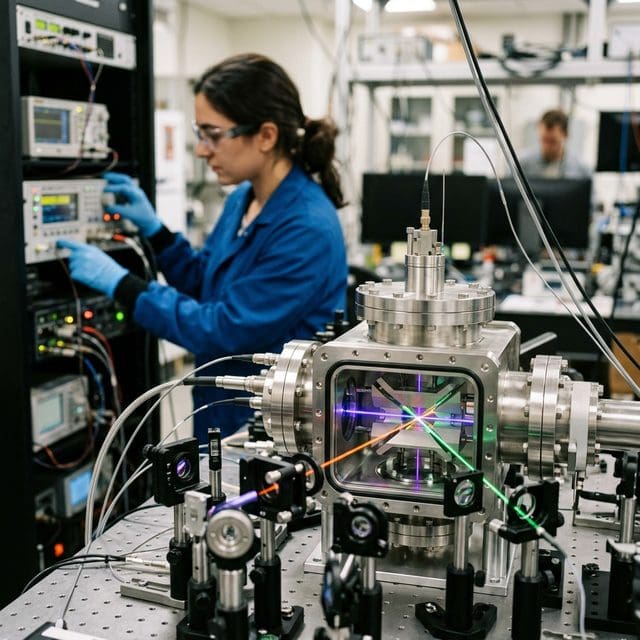
Trapped Ions and Quantum Oscillators Build the Simulation Loop
These mathematical frameworks describe how matter interacts with fundamental forces by placing matter points on a grid connected by gauge fields, presenting calculations that become increasingly difficult for conventional computers as the systems grow.
- Qubits: Encoded in the internal electronic states of trapped ions held by electromagnetic fields, representing gauge fields.
- Quantum Oscillators: Created by the vibrational motion of those same trapped ions, representing matter fields.
Connecting two oscillators with two intervening qubits created a closed loop, forming the basic building block required for the simulation. Digital operations handled preparation and measurement, while analog quantum evolution ran the interactions.
Destructive Interference Freezes Symmetrically Simulated Particle Motion
When the Oxford team ran their simulation without any simulated magnetic flux, a matter particle could move freely between locations around the loop through quantum tunneling. Bringing the flux into the setup radically altered the physical result, driving the particle’s potential trajectories to mutually negate each other and entirely halting its movement between the two sites.
Because the particle had two possible paths around the loop, the simulated magnetic flux altered their relative quantum phases. The two paths underwent destructive interference, canceling each other out entirely and leaving the simulated particle frozen in its starting position.
“For us, the exciting step was to encode the magnetic flux in a gauge field that was itself dynamical. Rather than having matter evolve in a fixed background, the matter and gauge field become part of the same quantum dynamics.”
Sebastian Saner, lead researcher and a postdoc researcher at Oxford University
That distinction separates this experiment from older demonstrations. As the researchers observed, creating a dynamical gauge field allows matter and the field to participate together in changing quantum behavior, rather than simply moving against a static backdrop. By embedding the flux straight into the qubits, the researchers found a functional workaround, transforming the magnetic flux into a component of the developing quantum apparatus instead of letting it stay a static, external force.
Scaling Challenges Remain for Future Particle Physics Simulations
Conventional computers struggle to calculate complex lattice gauge theories as systems grow larger and more demanding. Quantum simulation offers an alternative by constructing hardware systems that follow the same underlying rules.
While the Oxford experiment does not solve an immediate particle physics problem or prove that large quantum devices can tackle practical high-energy computations today, it tests whether hybrid hardware can reproduce difficult theoretical interactions.

Expanding these systems while preserving control and reliable measurements remains an ongoing challenge. For now, the Oxford demonstration provides physicists with a resource-efficient way to explore the interplay between charge and flux in controlled dynamical settings, offering scientists another way to explore the unusual rules governing the quantum world.