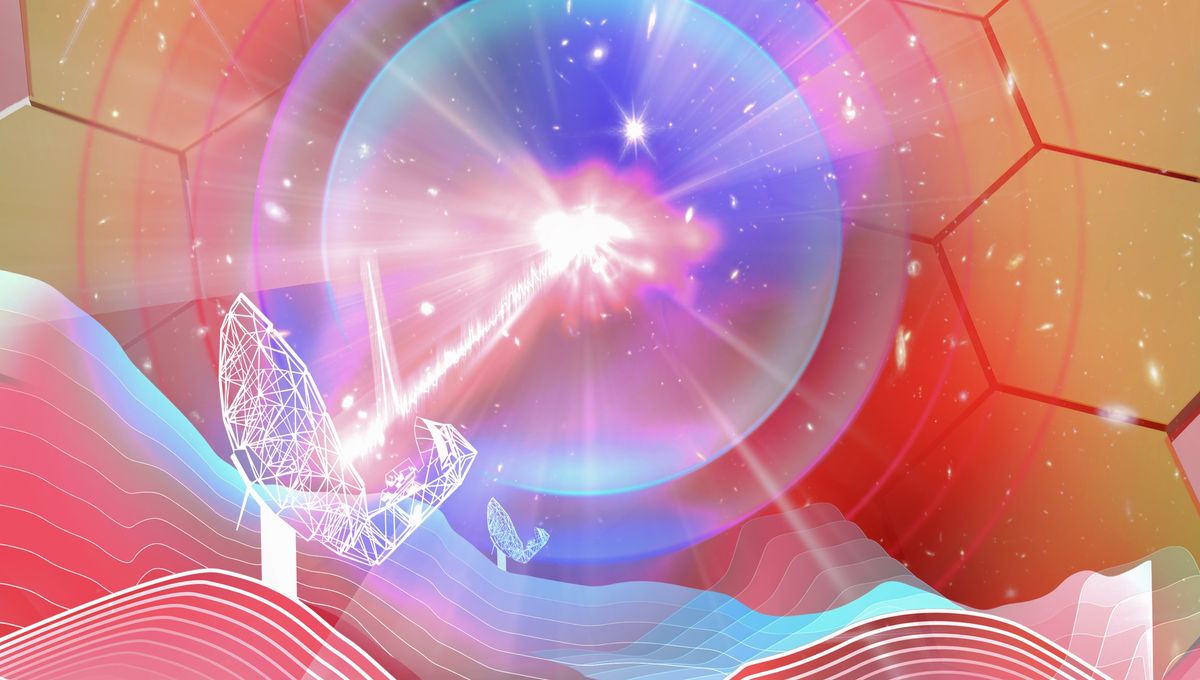
Astronomers have traced a millisecond-long radio flash from space to a tiny dwarf galaxy, revealing that the signal traveled more than 10 billion years before reaching Earth. The detection, designated FRB 20240304B, more than doubles the previous distance record for a fast radio burst and opens a new window into the early universe.
The cosmic signal erupted when the universe was only about three billion years old, roughly a quarter of its present age. Captured on March 4, 2024, by the MeerKAT radio telescope in South Africa, the flash arrived after crossing space for more than 10 billion years. Researchers detected the transient event using MeerTRAP, a system designed to catch fast-changing radio signals in real time.
MeerKAT and James Webb Space Telescope Measurements
While the MeerKAT array precisely localized where the signal originated, ground-based observatories could not spot anything at the coordinates. The host galaxy was too faint to be detected by standard ground-based telescopes. To solve the puzzle, the research team turned to NASA’s James Webb Space Telescope, whose infrared instruments finally revealed a small stellar system at the burst site.
Using the Near-Infrared Spectrograph instrument, astronomers measured the galaxy’s cosmological redshift at 2.148. That measurement confirmed that the fast radio burst occurred just three billion years after the Big Bang, setting a new benchmark for distance among localized fast radio bursts.
The global collaborative effort relied on cutting-edge space and ground facilities to pin down the precise coordinates and characteristics of the event.
Tiny Dwarf Galaxy Forms Stars Rapidly
The host galaxy itself defied expectations. Instead of a large, mature galaxy, the signal came from a tiny dwarf galaxy containing only about 10 million times the mass of the Sun. Observations showed the system was actively forming stars during a period known as cosmic noon, with most of its stellar population forming within a tight window of about 30 million years.
According to Dr. Laura Driessen, a co-author at the University of Sydney, the host environment is metal-poor and unusually compact. Dr. Driessen noted that finding such a unique stellar nursery provides critical information regarding the births of these transient events. Kavya Shaji, a doctoral student in the School of Physics at the University of Sydney, further noted that the properties of the host galaxy align closely with scenarios involving youthful stellar remnants rather than older binary mergers.
“We thought it would be a big, nicely formed galaxy with lots of stars, and instead it was a little dwarf galaxy, although it was actively forming stars.”
Manisha Caleb, University of Sydney
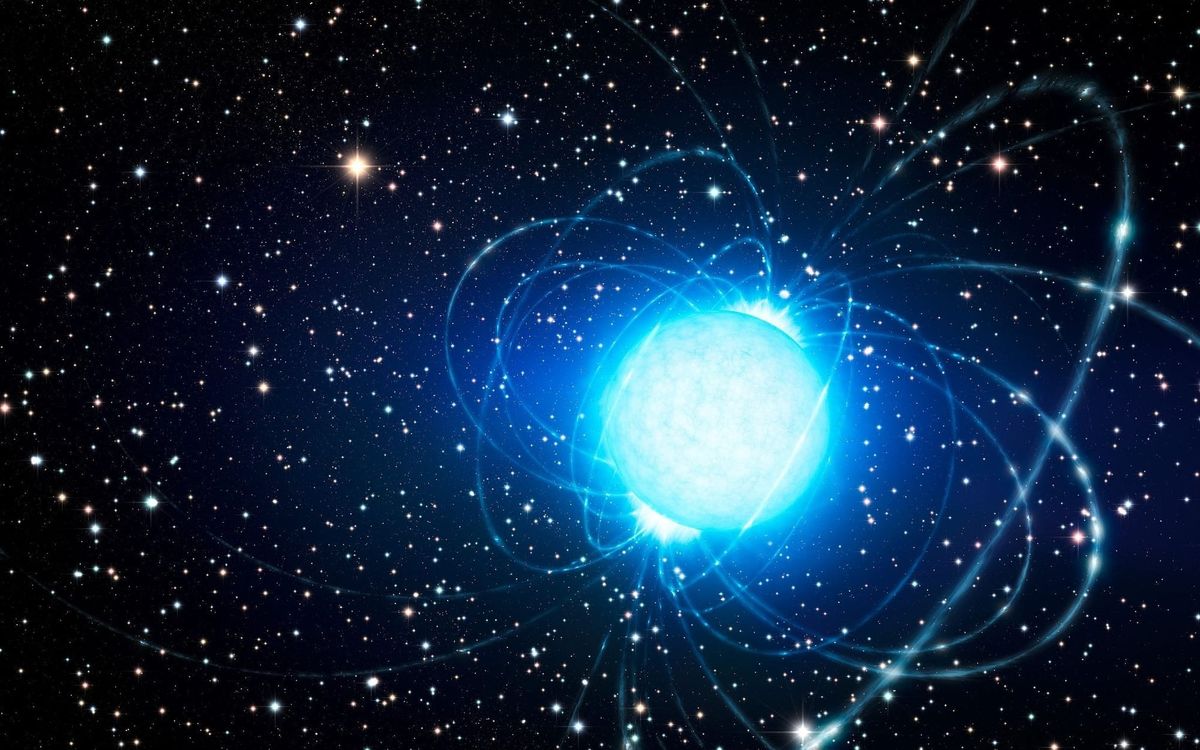
That compact structure and youth provide critical evidence regarding what triggers these powerful emissions. Because binary neutron stars take at least a billion years to spiral inward and merge, the youth of the host galaxy makes a neutron-star merger an unlikely explanation. Instead, researchers point toward an energetic starquake in a young magnetar—a highly magnetized neutron star born from the collapse of a massive star.

Cosmic Flashlights Illuminating the Universe
Beyond clarifying the potential origins of fast radio bursts, the record-breaking signal acts as a powerful probe of the universe. As the radio waves made their long journey to Earth, they passed through electrically charged matter, magnetic fields, and cosmic turbulence. That journey left an imprint on the signal through a process called dispersion.
By measuring how different frequencies of the radio burst arrived at slightly different times, scientists can calculate how much matter the signal traversed across billions of light-years. Researchers note that this technique allows astronomers to investigate vast reservoirs of gas and matter between galaxies that would otherwise remain invisible.
The research team intends to push observational boundaries even further. By capturing more distant events, astronomers hope to approach the first generations of stars and better understand how galaxies and their stellar populations evolved during the earliest epochs of the cosmos.