
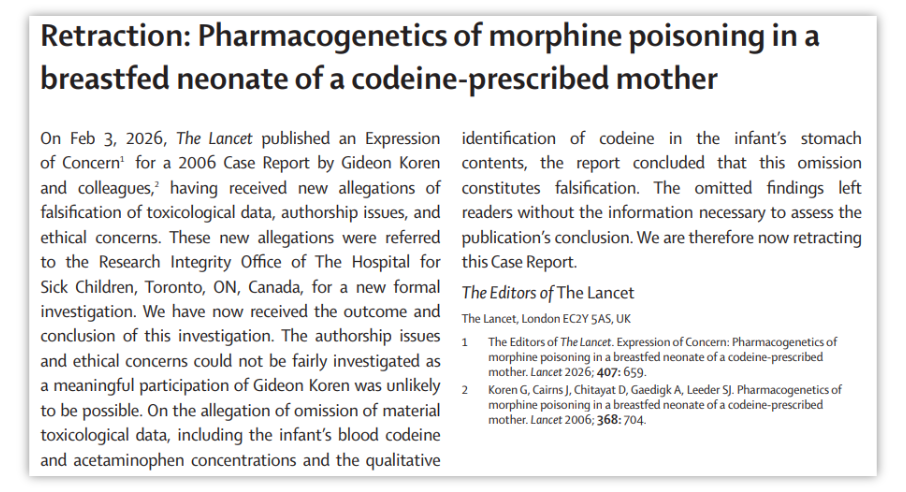
The retraction follows an investigation by the Hospital for Sick Children (SickKids) in Toronto, which concluded that the study’s authors omitted critical toxicology data — including the infant’s blood codeine and acetaminophen concentrations and the identification of codeine in the baby’s stomach contents — and that the omission constituted falsification.
“The “omitted findings left readers without the information necessary” to assess the publication’s conclusion,” the journal said in its retraction notice. The notice also said that authorship and ethical concerns could not be fairly investigated because meaningful participation by Gideon Koren was unlikely.
The case that changed prescribing worldwide
The 2006 paper, titled “Pharmacogenetics of morphine poisoning in a breastfed neonate of a codeine-prescribed mother,” described the death of an Ontario boy in 2005. His mother had been prescribed Tylenol 3, which contains codeine, after delivery. Koren, from SickKids, argued the mother was an ultrarapid CYP2D6 metabolizer who converted codeine into lethal amounts of morphine that passed into her breast milk.
Before the study, codeine was widely considered compatible with breastfeeding. After its publication, the U.S. Food and Drug Administration and Health Canada issued public health advisories recommending against codeine for nursing mothers. The FDA’s 2017 drug safety communication cited 19 papers; Koren was an author on seven, including the now-retracted Lancet report. The case report accumulated 464 citations, according to Clarivate’s Web of Science.
Years of challenge, a turning point in 2026
A 2008 letter in The Lancet questioned whether the morphine dose delivered through milk could plausibly be fatal. Two Canadian journals retracted related Koren papers in 2020 and 2021.
The Lancet added an “expression of concern” on February 3, 2026, and referred the allegations to SickKids’ research integrity office. The hospital’s inquiry concluded the omission of material toxicological data constituted falsification.
What the retraction does and does not change
The retraction removes the evidence that a mother’s breast milk alone caused fatal morphine poisoning in an infant. It does not establish an alternative cause of death, nor does it make codeine a preferred analgesic for breastfeeding women. FDA labeling has not changed. Health regulators continue to recommend avoiding codeine during breastfeeding because of concerns about opioid-related side effects in infants, including excessive sleepiness, poor feeding, and respiratory depression.
Juurlink told Retraction Watch that a co-author of the case report once admitted to him, “Oh, we made it up,” and later wrote in an email that the case was invented as “a cautionary tale” for medical students about the dangers of opioid prescribing.
Hale’s reference already flagged the case as questionable
Kaytlin Krutsch, coauthor of Hale’s Medications & Mothers’ Milk and director of the InfantRisk Center, identified the problems with the case in an August 2025 Q&A with Springer Publishing, months before The New Yorker story and The Lancet’s expression of concern.
FDA and CDC guidance still cite the retracted report
The CDC’s “Treating for Two” opioid fact sheet advises breastfeeding mothers to “avoid codeine whenever possible,” citing the 2017 FDA Drug Safety Communication as its primary reference, Pain News Network reported. That FDA communication relied heavily on Koren’s Lancet case report, the network said.
FDA labeling has not changed since the retraction, multiple outlets confirmed.
Clinical guidance after the retraction
Clinicians are advised to prefer non-opioid analgesics such as acetaminophen and ibuprofen for postpartum pain. If codeine is used, guidance suggests limiting duration to the shortest possible course, generally two to three days, avoiding combination with other sedating medications, and educating parents on early signs of opioid exposure in infants — excessive sleepiness, poor feeding, hypotonia, and shallow or irregular breathing — without defaulting to unnecessary breastfeeding cessation.
The full SickKids inquiry report remains confidential. The Lancet said it would not provide further details because of the confidential nature of research integrity inquiries.
Worth a look
- Nvidia Board Reinstates Jensen Huang as CEO
- Latvia’s Harmony Party Votes to Dissolve After Election Defeat
- Slow Freezing in Deep Fractures Explains Enceladus’ Varied Salty Ice Grains, Study Finds (archyde.com)
- Manchester study finds nine per cent of volunteers had silent heart attacks (newsarchyuk.com)