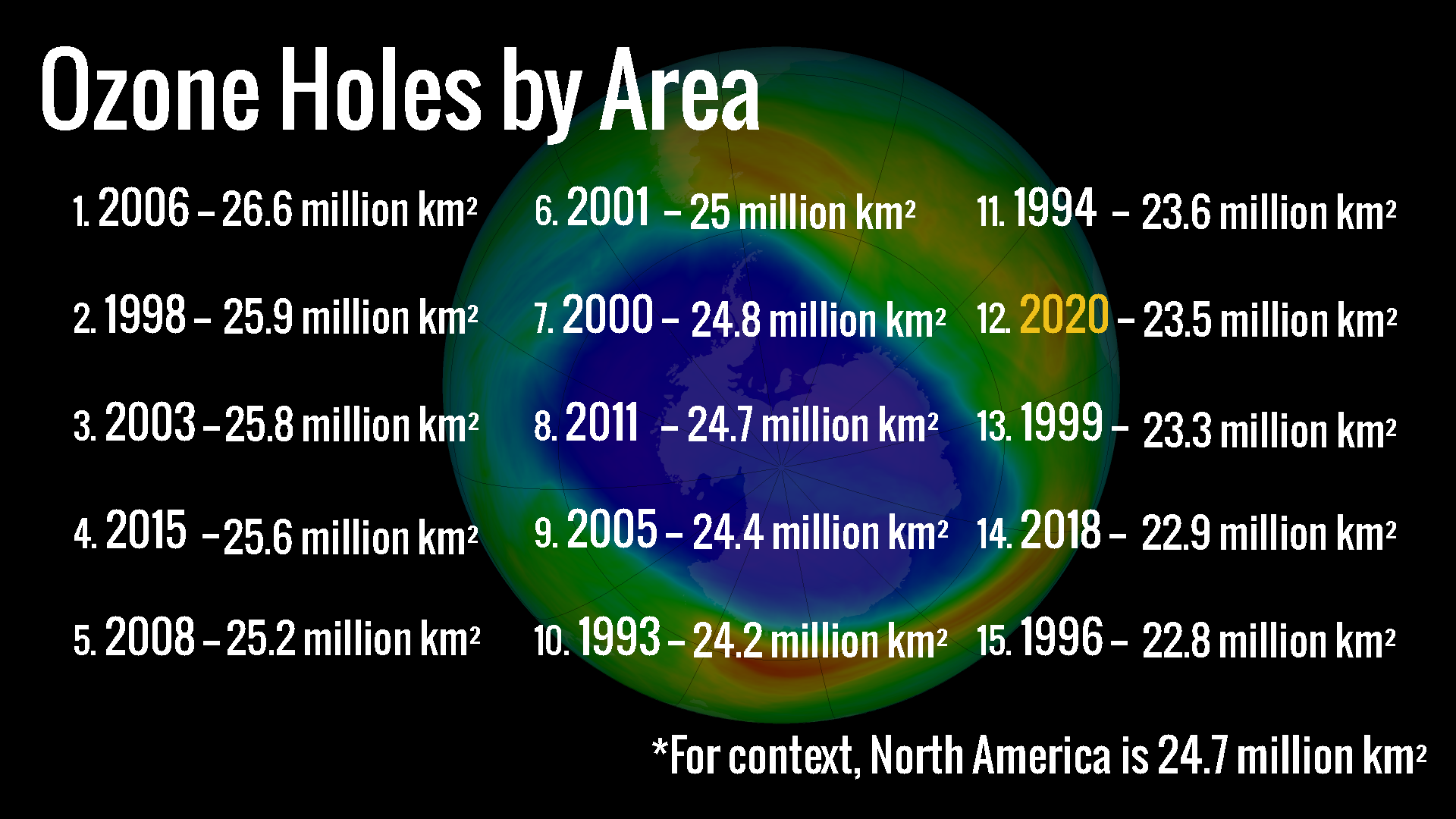
The Antarctic ozone hole hit roughly 25 million square kilometers on September 12, 2026, according to the Copernicus Atmosphere Monitoring Service — about 5 million square kilometers above average for that date, after expanding sharply through early September following a typical start in August.
An abrupt cold snap high above the South Pole appears to be the trigger. CAMS, run by the European Centre for Medium-Range Weather Forecasts (ECMWF), reported that the hole grew from about 15 million square kilometers at the end of August — slightly earlier than the long-term average — to roughly 25 million square kilometers by September 12, exceeding the total area of Antarctica itself.
That’s a big jump in a short window, but CAMS is careful to note that hole area is only one measure of ozone depletion, and it’s the one that moved.
Why September’s Cold Snap Matters More Than the Headline Number
The rapid expansion tracked a sudden drop in minimum temperature near 20 kilometers above the South Pole, at the 50-hectopascal level, according to CAMS. Cold conditions there let polar stratospheric clouds form, and those clouds drive the chemical reactions that activate halogens in sunlight, ripping apart ozone molecules across the Southern Hemisphere spring, which typically runs August through November.
Laurence Rouil, Director of CAMS, framed the numbers cautiously rather than alarmingly. The Antarctic ozone hole’s development can vary considerably from year to year, depending on a range of atmospheric and chemical factors,
he said, adding: While we have seen its area increase rapidly in early September this year, other indicators remain close to historical averages.
That distinction — area up, other indicators flat — is the piece easy to miss if you only read the size figure. CAMS tracks the hole using several yardsticks beyond area: the ozone-column minimum (the lowest concentration found inside the hole), the ozone mass deficit (how much ozone is actually missing) and stratospheric temperature. In 2026, area has run well above average while the minimum and mass-deficit readings have stayed close to typical values, a split CAMS says underscores the importance of monitoring the complicated interaction between human-made disturbances and natural factors.
How 25 Million Square Kilometers Stacks Up Against Past Years
Context helps here. The Antarctic ozone hole is defined as the region south of 60 degrees south latitude where ozone-column concentrations drop below 220 Dobson Units, and scientists have tracked it with ground and satellite instruments since the late 1970s. Its largest recorded area in the CAMS dataset was 29.6 million square kilometers, measured on September 9, 2006. The 2026 hole, at 25 million square kilometers, sits well below that record but well above this year’s seasonal norm.
The 2026 season also tracked closely with 2025 through late August — both years reached the 15-million-square-kilometer threshold at almost the same point, with 2025 hitting it on August 30. Where the two years diverge is what happened next: 2026’s hole kept expanding through the Antarctic spring rather than leveling off, according to CAMS data reported by the Daily Mail. CAMS notes that recent years have generally produced smaller, shorter-lived ozone holes than the 1980s and 1990s, which it frames as a sign of gradual recovery — even as it stresses that any single season can still swing well outside the average.
A Separate NASA-NOAA Reading From 2020 Shows the Same Pattern, Different Year
NASA and NOAA scientists reported a comparable dynamic during the 2020 Antarctic season, when persistent cold temperatures and a strong polar vortex pushed that year’s hole to about 24.8 million square kilometers at its September 20 peak — the 12th-largest on record in 40 years of satellite data at the time. Paul A. Newman, chief scientist for Earth Sciences at NASA’s Goddard Space Flight Center, said Antarctic stratospheric chlorine and bromine levels had fallen roughly 16% from their year-2000 peak toward natural levels, and credited that decline with keeping the 2020 hole about a million square miles smaller than it would otherwise have been.

Bryan Johnson, a scientist with NOAA’s Global Monitoring Lab, described 2020 ozone readings in the critical 8-to-13-mile altitude band as about as close to zero as we can measure.
He added that the pace of ozone loss in September had slowed compared with two decades earlier, which he tied to the atmosphere carrying less chlorine than before. That 2020 episode is a different season than the current 2026 story, but it establishes the same causal chain CAMS is now describing: cold stratospheric temperatures, polar stratospheric clouds, activated halogens, and a bigger hole — layered on top of a chemical baseline that keeps slowly improving as Montreal Protocol controls take effect.
What Happens Between Now and November
CAMS forecasts, as of the September 12 reading, pointed to a further increase in the hole’s area through mid-September, even as its ozone-column minimum and mass-deficit indicators stayed near historical norms. The Daily Mail reported the same forecast trajectory, noting the hole typically reopens each austral spring and closes again by November.
None of the three sources link this month’s expansion to global temperature records directly, though the Daily Mail noted the timing coincided with CAMS confirming August 2026 as the warmest August on record globally, with Samantha Burgess, Strategic Lead for Climate at the European Centre for Medium–Range Weather Forecasts (ECMWF), saying global temperatures reached 1.65°C above pre-industrial levels that month. CAMS itself draws no causal line between that warmth and the ozone hole’s growth — the two findings appear in the same reporting window but are not presented as connected. What CAMS does commit to is continued tracking of ozone concentration, temperature and hole size as the Antarctic spring plays out, the same monitoring regime Rouil pointed to when he said CAMS provides the high-quality data, forecasts and analyses needed to understand the state of the ozone layer and track its long-term recovery.