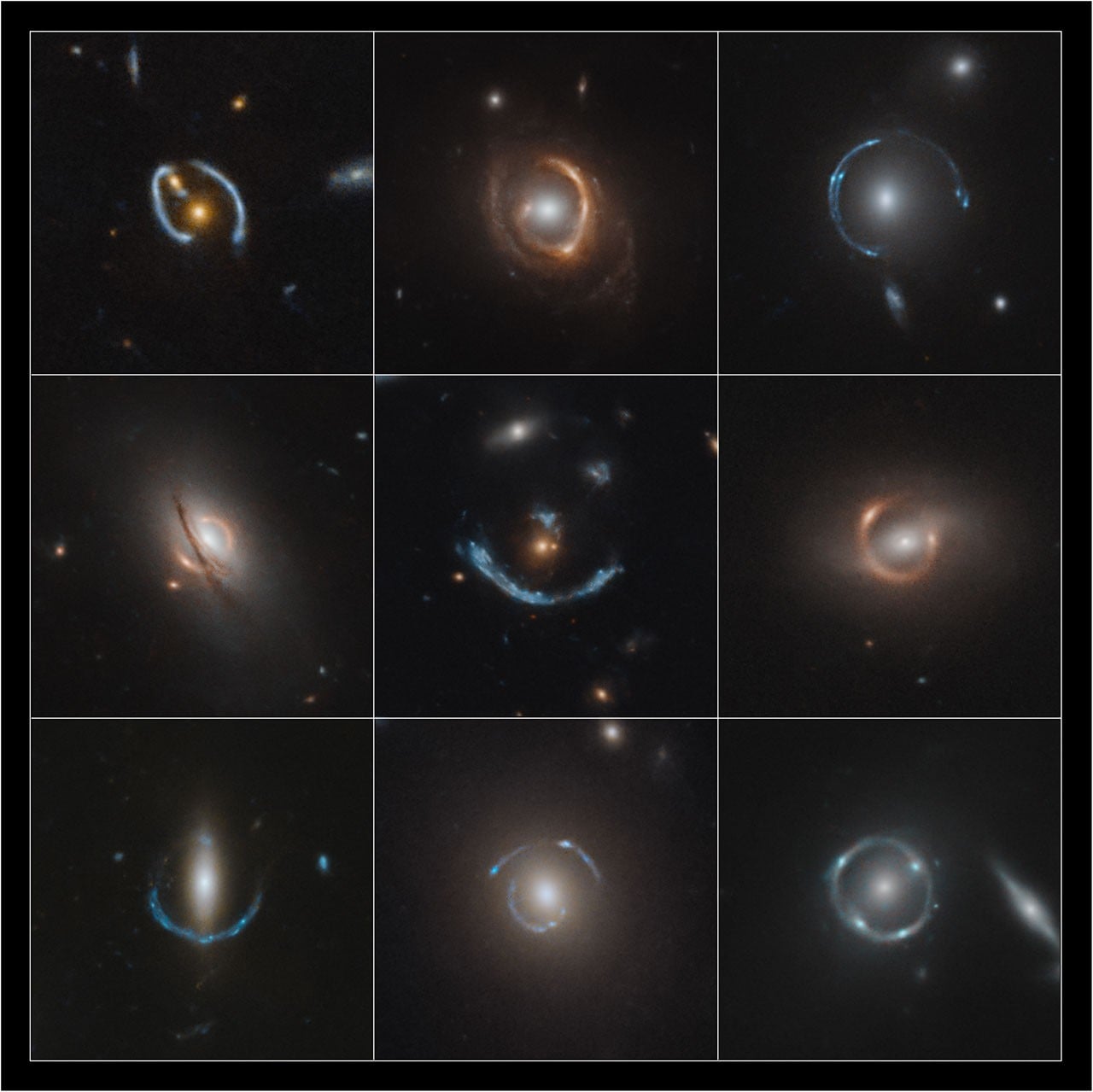
Astronomers have a new set of Hubble images of gravitational lenses that will guide the Nancy Grace Roman Space Telescope as it begins hunting for far more of them.
NASA published a gallery of Hubble-imaged lenses that lays groundwork for Roman follow-up. Each lens forms when a foreground galaxy’s gravity bends and magnifies light from a more distant galaxy behind it, producing arcs around the nearer object.
The pairing is deliberate. Hubble gets the sharper view of individual lenses, while Roman’s wider field of view lets it capture many more of them. If Roman spots an especially interesting lens, researchers may turn Hubble back to it for follow-up in visible and ultraviolet light.
What the lens gallery shows
The panels illustrate the variety Roman’s models will have to handle.
The foreground galaxy in Panel D shows a dust lane, an uncommon feature in a lensing galaxy and exactly the sort of detail that Hubble’s sharp, visible-light vision is so good at revealing. Since dust obscures infrared light less, Roman’s future infrared observations could help establish whether the arcs make up a more complete Einstein ring.
Color carries information too. Bluish arcs indicate young stars, while reddish arcs older ones, and Roman and Hubble will explore these differences to better understand how galaxies evolved earlier in the universe. The strong lenses were first detected with The Dark Energy Spectroscopic Instrument at Kitt Peak.
Dark matter is the prize
The amount of distortion tells astronomers how much mass sits in the foreground galaxy, including dark matter that cannot be seen.
Hubble’s detailed models should also be able to spot slight irregularities in these gravitationally lensed galaxy arcs, which would signal small clumps of dark matter.
These previously undetected clumps could let researchers confirm the cold dark matter theory, which predicts many small dark matter clumps of between a million to a billion solar masses. By comparison, the dark matter halo of our Milky Way galaxy is around 1.3 trillion solar masses. Researchers also plan to build a super-intelligence tool from the Hubble images to efficiently search similar arcs in the upcoming Roman images.
Roman arrives better than planned
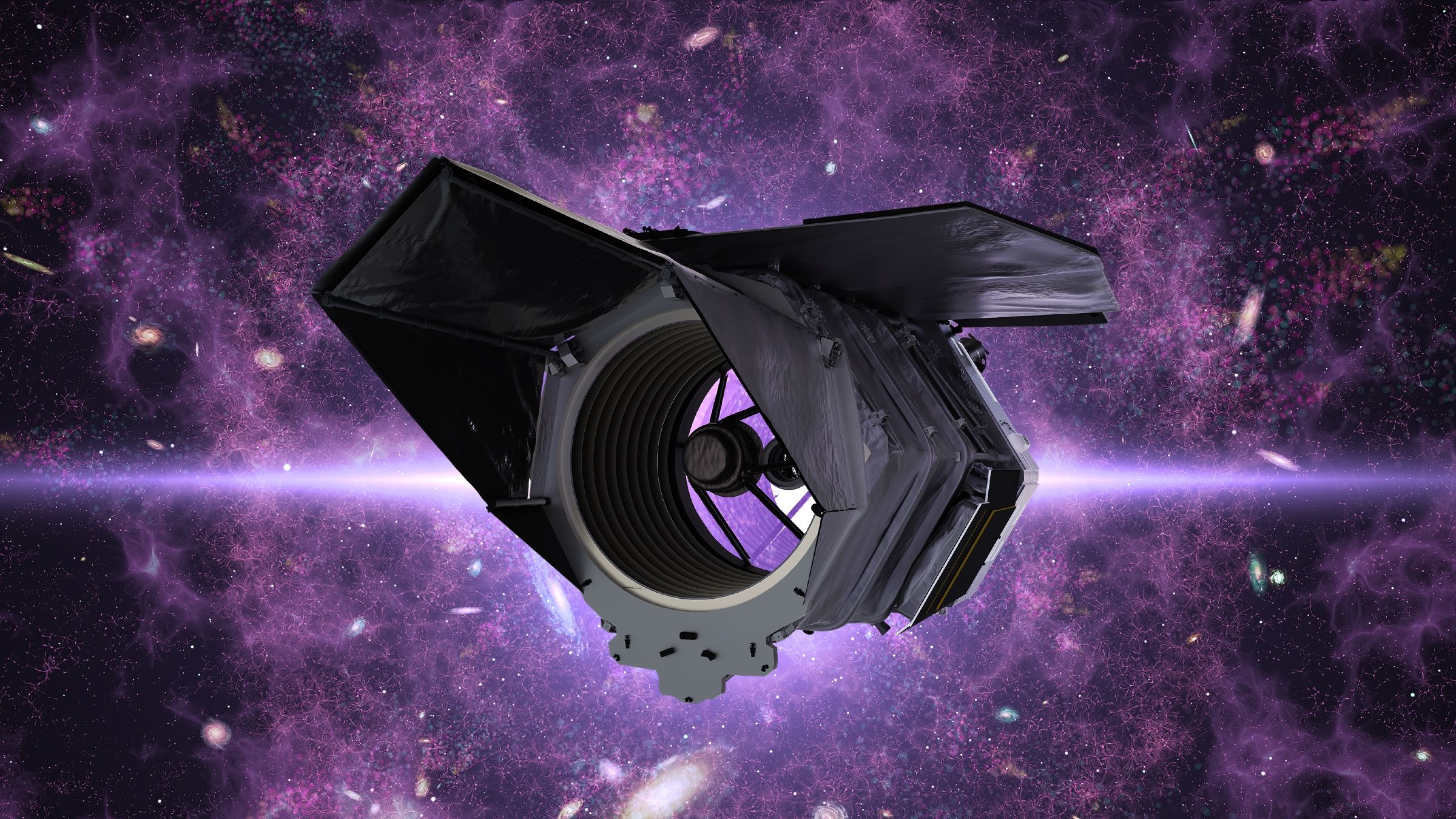
Roman successfully launched into space on Aug. […] and is headed for Lagrange point 2, according to Live Science. As a flagship mission, the $4 billion machine — over 42 feet (12.7 meters) long and about as heavy as a fully grown Tyrannosaurus rex — stands alongside Hubble and the James Webb Space Telescope (JWST).
After engineers adjusted the mirror, images should show about 30% more detail than predicted.
Recent developments suggest Roman could take better images than initially expected, and astronomers are delighted by the news.
“It is fantastic to learn that Roman is not just reaching its design goals but exceeding them,” Eamonn Kerins, an astronomer at the University of Manchester in the U.K. who will help lead one of Roman’s major surveys, told Live Science.
Roman’s propulsion team reportedly benefited from the telescope coming in lighter than budgeted, which let them fill the propellant tanks fully. The extra fuel could let Roman operate for more than twice as long as initially expected, which means it could still be capturing images of the cosmos in 2048.
Wide view, deep view
Live Science reported that Roman’s Wide Field Instrument (WFI), arguably its secret weapon, combines a 288-megapixel camera with a 7.9-foot (2.4 m) mirror and will capture ultra-detailed images across a field of view roughly 100 times larger than Hubble’s.
ESA’s factsheet notes that a survey this wide is useful for choosing targets for missions such as Webb that look narrower but deeper. It also says Roman carries a coronagraph that blocks starlight to image planets a billion times fainter than their stars.
Eamonn Kerins, who will help lead one of Roman’s major surveys, said that with a 20-year Roman lifetime, “we could, in theory, do over 20,000 years of Hubble survey work.” For lensing, that means a long runway: Hubble’s lens images now, and a much larger catalog to test them against later.
“The real show-stopper results will be new things we just aren’t even thinking about right now,” Kerins said.