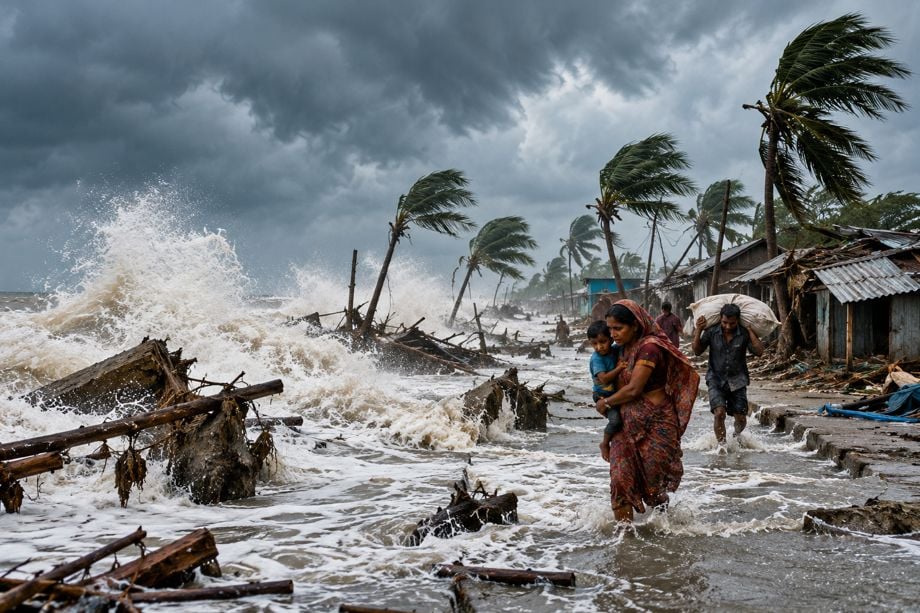
A study by the Asian Development Bank and Australian National University finds that coastal disasters in Asia and the Pacific do far more harm to people than damage tallies show. Published in October 2026, it tracks losses in food, health, work and safety that standard assessments rarely count.
The research is ADB Economics Working Paper No. 865, Well-Being Losses from Coastal Hazards, by Sonia Akter and Madhavi Pundit. It examines cyclones, coastal flooding, rising seas and saltwater intrusion.
Governments, it argues, tend to count wrecked buildings, damaged roads and financial losses while missing the effects on health, food security, jobs, safety and social life.
1 Billion People Within 10 Kilometres of the Coast
More than 400 million people in the region live within 10 kilometers of the sea, according to the report. That is more than 1 in 10 of the residents of ADB’s developing members that have a coastline. An estimated 44.1 million live less than one metre above mean sea level.
Poorer households are hit hardest, the study says, because they often lack savings, insurance and basic services. Their recovery can be difficult even when the recorded financial loss looks small.
Study Tracks Nine Areas of Well-Being
Coastal hazards affect nine areas, the authors say: food security, water and sanitation, employment, unpaid household work, displacement, physical and mental health, safety, cultural identity and environmental resources. They are linked, so one storm can pile several problems onto the same household.
Food comes first. Cyclones and saltwater intrusion destroy crops and disrupt fishing and supply chains, and families may skip meals or eat less nutritious food. The study says children and pregnant women face particular risk if shortages last.
2,031 Interviews Test the Idea After Cyclone Remal
To test the idea, researchers studied the aftermath of Cyclone Remal, which struck near the Bangladesh–India border in May 2024. They covered 37 coastal villages: 19 badly affected and 18 comparison villages with limited damage. Interviewers held 2,031 face-to-face interviews about a week after the storm. Women made up 60% of respondents.
The burdens fell unevenly. Women had more trouble reaching healthcare and spent more time fetching water and fuel. Men reported bigger job and income losses, especially in fishing, transport and daily wage work, and more sanitation difficulties. Women with less schooling reported more food insecurity than men with similar schooling.
Reports of gender-based violence also surfaced in the more heavily damaged areas. The survey did not ask people directly about personal experience, citing privacy and safety concerns. Unpaid work such as hauling water, the study notes, cuts into education, employment and rest yet rarely shows up in official disaster statistics.
Authors Propose a 10-to-15-Minute Survey for Governments
The authors propose a Coastal Well-Being Loss Measurement Framework built on short, standardized surveys of 10 to 15 minutes. These would cover food consumption, drinking water, healthcare access, work, unpaid labour, displacement, safety and environmental conditions. Unlike assessments that lean on household heads, the framework would gather data from individuals and break results down by sex, age and other traits.
Development partners could use them in designing adaptation programmes and in loss-and-damage financing decisions.
The study’s conclusion is blunt: rebuilding roads, homes and markets is only part of recovery. Governments must also address lasting effects on health, livelihoods, dignity, cultural identity and community relationships.