Google rolled out Gemini 3.8 Live and Gemini 3.8 Live Extended Thinking on September 15, 2026, new voice-AI models now running Search Live and available through the Gemini API, Google AI Studio and Gemini Enterprise, according to Google and multiple outlets confirming the launch.
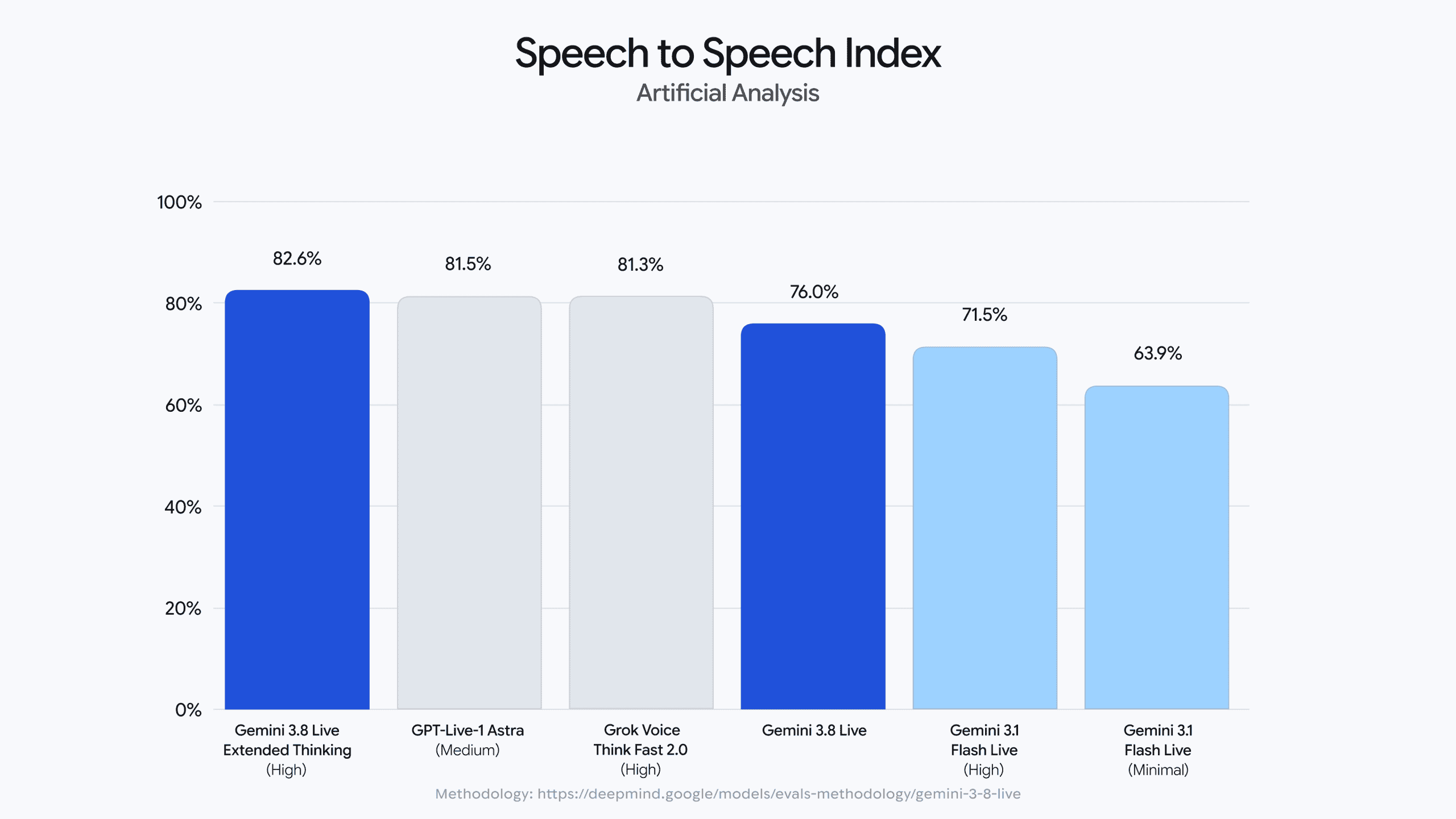
Search Live’s audio conversations now run on Gemini 3.8 Live, Google confirmed, swapping in a model the company says scores 82.6 on Artificial Analysis’ Speech to Speech Quality Index for its Extended Thinking variant — a benchmark Google says puts it ahead of OpenAI’s latest GPT-Live-1 models. The rollout touches everything from Google Workspace apps to enterprise voice agents, but the most visible change for ordinary users lands inside Search Live itself.
Rajan Patel Confirms the Search Live Switch
Rajan Patel, VP of Engineering for Search and co-founder of Google Lens, announced the change directly, writing on X that the new model is already live for everyone using the feature, as Seroundtable reported.
New Gemini audio models just dropped – 3.8 Live is now powering real-time conversations in Search Live.
Rajan Patel, VP, Engineering for Search and co-founder of Google Lens
Patel’s post listed three concrete improvements: more helpful responses that come with web links to dig deeper, fluid multilingual support that lets a user switch languages mid-conversation, and more natural, free-flowing exchanges. Seroundtable notes Search Live launched globally in March after Google dropped its opt-in requirement, so this marks an upgrade to an already-established feature rather than a brand-new product.
Two Models, Two Jobs: Live vs. Extended Thinking
Google built the pair for different workloads. Gemini 3.8 Live is, in the company’s own framing on its official blog post, built for scale and cost efficiency, combining conversational intelligence with fluid dialogue and visual grounding.
Gemini 3.8 Live Extended Thinking is aimed at harder, multi-step tasks — it can reason and speak at the same time, using verbal filler to acknowledge a request while it works out the answer in the background, according to Google.

Both models detect and switch between 97 languages mid-conversation and can fire off tool calls or API requests without breaking the conversational flow, Unite.AI reported, citing Google’s announcement from principal engineer Tom Ouyang and technical staff member Malini Jaganathan of the Gemini Audio Team. Demo videos accompanying the launch show the standard model narrating a chess game and guiding an employee onboarding session using on-screen visual context, while Extended Thinking demos show it turning rough sketches into working React code and coordinating a multi-step restaurant reservation through background function calls.
The Benchmark Fight With GPT-Live-1 and Grok Voice
Google is not shy about naming its competition. According to officechai.com, Gemini 3.8 Live Extended Thinking’s 82.6% on the Speech to Speech Quality Index edges out GPT-Live-1 Astra (Medium) at 81.5% and Grok Voice Think Fast 2.0 (High) at 81.3%. The gap widens on agentic performance: Extended Thinking hits 68.6% on Artificial Analysis’ τ-Voice benchmark against GPT-Live-1 Astra’s 67.9% and Grok Voice Think Fast 2.0’s 56.5%. On Sierra’s τ-Voice-banking benchmark, which tests whether a voice agent can actually close out a customer-service task, Extended Thinking leads with 35.1%, ahead of GPT-Live-1 Astra’s 32.0% and xAI-Realtime’s 16.5%.
Google also says the models push the Pareto Frontier on ServiceNow’s EVA-Bench, a benchmark for evaluating voice agents on complex workflows, balancing accuracy against conversational quality, according to Unite.AI’s account of Google’s announcement. Google reports the Extended Thinking model separately scores 97.7% on Big Bench Audio, a measure of reasoning quality.
Two Different Price Tags for the Same Story
Here the sources diverge on how they frame the cost, though not on the underlying numbers each cites. The-Decoder reports Google charges $0.005 per minute for audio input and $0.018 per minute for output, versus OpenAI’s GPT-Live-1 at $0.05 per minute — putting an hour of voice conversation at about $1.38 with Google versus at least $3.00 with OpenAI. Officechai, using Artificial Analysis’ cost-per-hour measure on the Big Bench Audio subset, cites different figures: Gemini 3.8 Live at $0.84 an hour and Extended Thinking at $3.50 an hour, against $4.80 for Grok Voice Think Fast 2.0 and $5.83 for GPT-Live-1 Astra.

| Model | Reported Cost | Source |
|---|---|---|
| Gemini 3.8 Live | $0.84/hour (Big Bench Audio) | officechai.com |
| Gemini 3.8 Live Extended Thinking | $3.50/hour | officechai.com |
| Grok Voice Think Fast 2.0 | $4.80/hour | officechai.com |
| GPT-Live-1 Astra | $5.83/hour | officechai.com |
| Google (per-minute basis) | ~$1.38/hour | the-decoder.com |
| OpenAI GPT-Live-1 (per-minute basis) | at least $3.00/hour | the-decoder.com |
Whichever figures a reader trusts, the direction is the same: Google is pricing its voice models well under what it says OpenAI charges. The-Decoder’s own read on quality cuts the other way, though, noting that OpenAI’s model “should still deliver more natural conversations thanks to full duplex that lets it listen and speak at the same time,” and that, judging from the demos, it also sounds better, suggesting Google once again optimized for price over quality
.
Where the Models Show Up — and Google’s SynthID Watermark
Gemini 3.8 Live is rolling out through the Gemini API, Google AI Studio and Search Live, with enterprise access through Gemini Enterprise, officechai.com reported. Gemini 3.8 Live Extended Thinking gets the same developer and enterprise release plus a consumer rollout inside Gemini Live and the Workspace apps Docs, Gmail and Keep, limited to Google AI Pro and Ultra subscribers. Every audio output from both models carries Google’s SynthID watermark, a detail confirmed by officechai.com and separately by stadt-bremerhaven.de’s coverage of the launch.
Google says it’s partnering with developer platforms including Agora, Fishjam, LiveKit, Pipecat, Vercel and Vision Agents to help build voice interfaces on the Live API, alongside enterprise partners Salesforce, Genspark, ServiceNow and Lumeris, according to Unite.AI.
None of the sources address how the two benchmark tables — the-decoder’s per-minute pricing and officechai’s per-hour Big Bench Audio pricing — reconcile with each other, or whether Google plans further updates to Search Live’s voice feature beyond the September 15 rollout Patel announced.