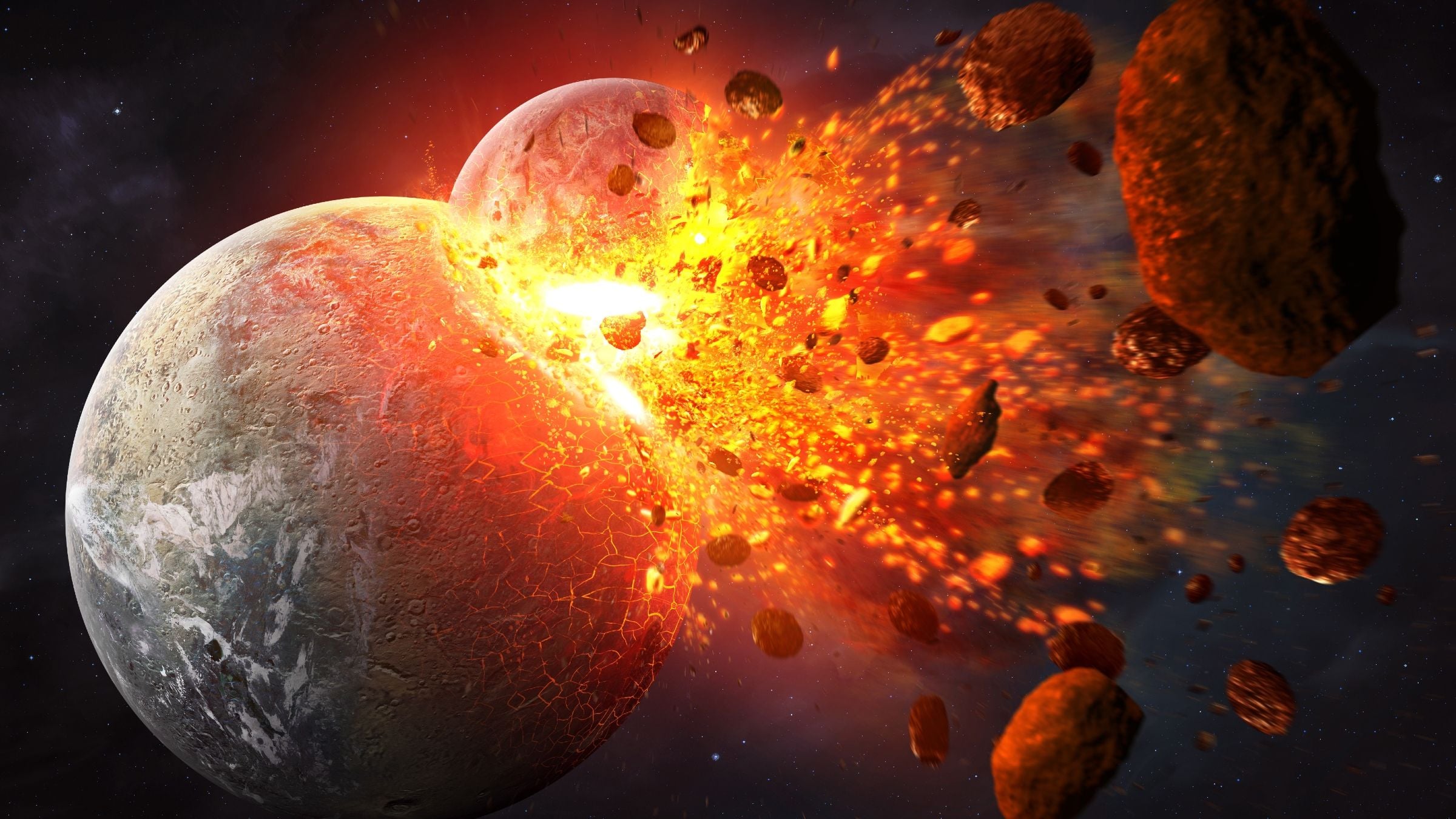
The Moon may have taken shape within about five hours of the collision between the young Earth and Theia, a Mars-sized body, according to new computer simulations that account for the physical strength of the rocky worlds involved.
The result challenges the familiar picture of the Moon slowly assembling from a broad disk of debris. In some of the simulations, the impact destroyed Theia and produced a disk that gradually came together. In others, a largely intact Moon emerged almost immediately after the collision.
Strength changes the outcome
The study was conducted by researchers at the Southwest Research Institute and the University of Arizona. Their work revisited the giant-impact explanation for the Moon’s origin, which holds that Theia struck the early Earth about 4.5 billion years ago and sent material into orbit.
Earlier models generally focused on the masses of the colliding bodies. Many also treated Earth and Theia much like fluids, on the assumption that the violence of the impact would melt or vaporize so much rock that the strength of the material would not matter.
The new simulations instead incorporated temperature-dependent geological strength.
We discovered that the preexisting geology of the Mars-sized proto-moon matters,
Adeene Denton said, according to an account of the study. Denton is identified there as a former postdoctoral researcher at the University of Arizona’s Lunar and Planetary Laboratory who is now at the Southwest Research Institute.
When you simulate the Earth and the Moon as colliding bodies with geologic properties, it changes how the Moon forms out of that impact – that's something we considered unnecessary before, Denton said
Heat may have helped preserve the forming Moon
Temperature was the main factor governing the strength of the colliding bodies. Earth and Theia were young when they met, and both would have been hot, with soft or molten surfaces. Under those conditions, the collision could have been cushioned, allowing material to remain in larger pieces rather than spreading into a much wider field of debris.
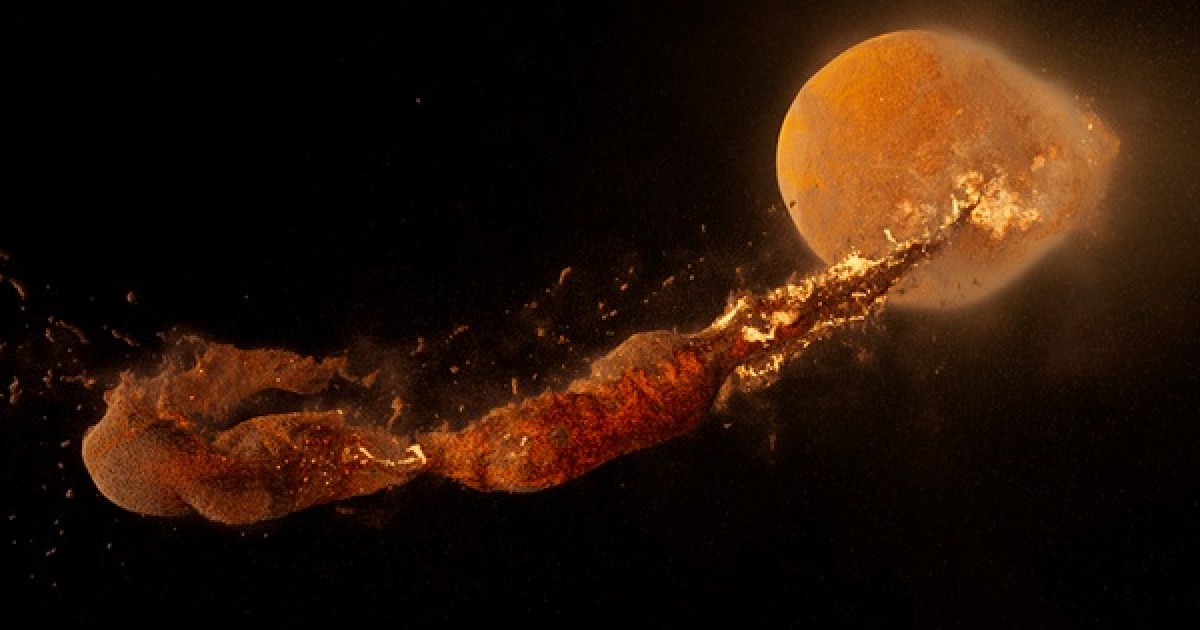
Researchers tested a range of possible temperatures. In the hottest scenario described by Live Science’s report, the Moon formed in as little as five hours.
In another set of results, the researchers used temperature structures matching those in the original impact modeling, including equal temperature structures inside Earth and Theia. Under those conditions, an intact Moon appeared within roughly five hours.
Colder bodies behaved differently. When the colliding worlds were more brittle, the impact was more likely to create a larger debris field that would require additional time to coalesce. The results therefore connect the Moon’s formation not only to the impact itself but also to when the collision occurred in the early history of the solar system.
A long-standing origin puzzle
Samples returned from the Moon show that it is about 4.5 billion years old. The collision that created it is thought to have occurred roughly 100 million years after the Sun was born.

The giant-impact explanation remains one of the leading accounts of lunar formation, but it has faced questions about the Moon’s composition. Lunar rocks have isotopic signatures that closely, though not perfectly, match material from Earth’s mantle. The new simulations change how material could have been distributed after the impact, but they do not by themselves settle why Earth and Moon rocks are so similar.
Under some simulated conditions, Theia was destroyed and a broad protolunar disk formed around Earth. Material in that disk then gradually assembled into the Moon.
Implications beyond the Moon
The findings emphasize that material strength may be important in modeling collisions involving smaller planetary bodies, including asteroids, dwarf planets and moons.
For now, the new models offer a revised timeline for the Moon’s earliest moments: rather than emerging only after a long period of gradual accumulation, it may have appeared almost intact within hours of the impact that reshaped the young Earth.