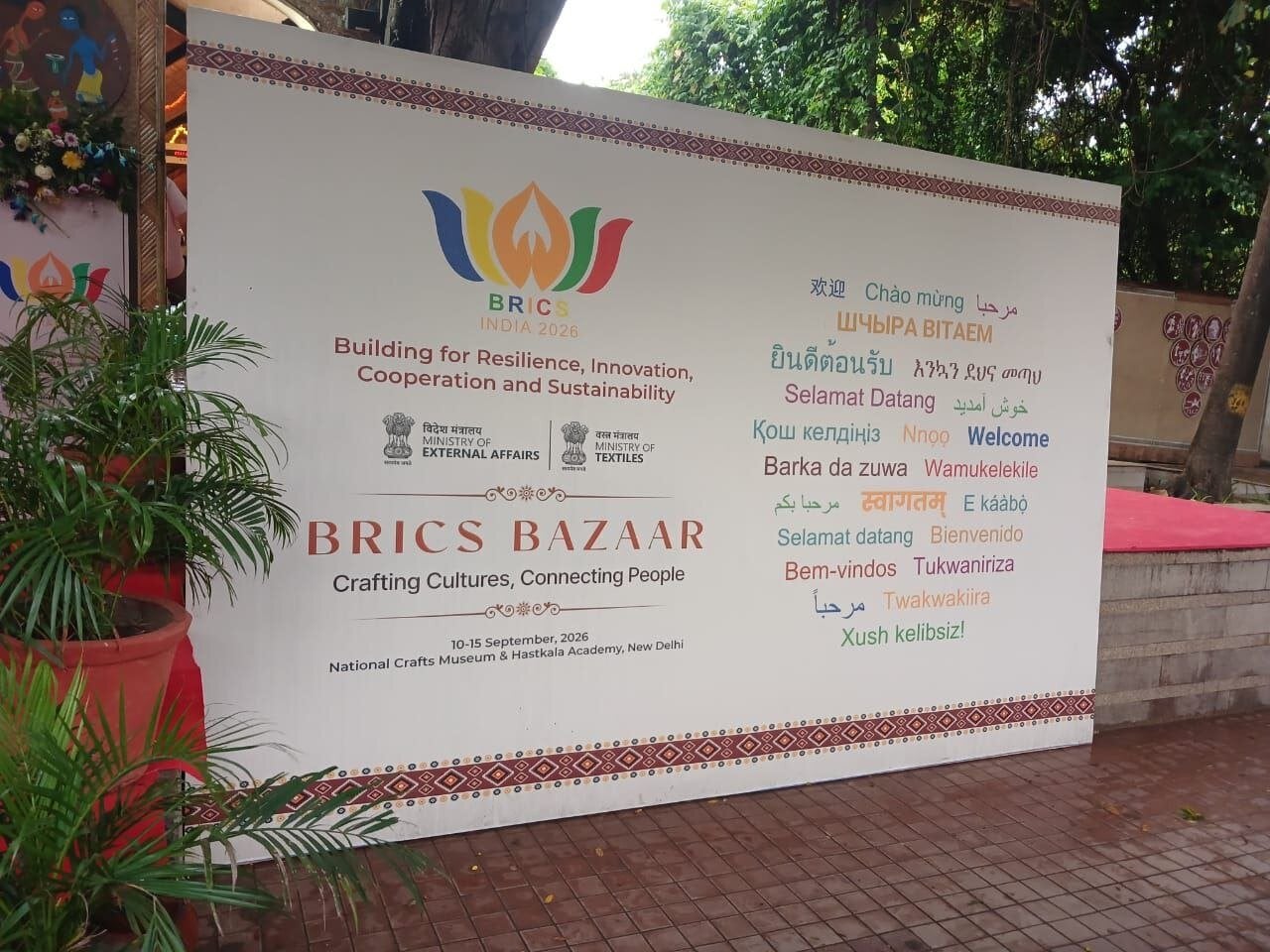
Female artisans from Iran and across an expanded bloc gathered in New Delhi on Saturday to showcase centuries-old textile traditions at the BRICS Bazaar. Running alongside the 18th BRICS Summit, the cultural exhibition highlights craft heritage, cross-border artistic exchanges, and diplomatic outreach among member states and partner nations.
Organized jointly by India’s Ministry of Textiles and Ministry of External Affairs, the five-day exhibition runs from Sept. 10 to 15 at the National Crafts Museum & Hastkala Academy. Held under the banner Crafting Culture, Connecting People,
the event gathers more than 40 artisans, designers, and creative enterprises representing 11 member states and 18 partner countries. The gathering unfolds parallel to the summit proceedings held at Bharat Mandapam, where India’s 2026 chairship has centered discussions on resilience, innovation, cooperation, and sustainability.
Silk Hooks and Balochi Stitches from Gilan to New Delhi
At the center of Iran’s presence are traditional embroidery techniques presented directly by the women preserving them. Ameneh Sedighi, an artisan from Iran’s northern Gilan province, traveled to New Delhi to demonstrate Rashti-doozi, an ornate embroidery method executed with a special hook and natural silk thread sourced from Gilan. The practice dates back between 330 and 550 years before Christ. While historically practiced by men, the needlework is now carried out by women.
Iranian reporting noted that handmade carpets from participating countries were arranged in a circle at the venue’s entrance to display regional diversity. Visitors, particularly Indian attendees, demonstrated sustained interest in the textile demonstrations, while observers noted visible craft similarities between Kashmiri needlework and Iranian traditions. Iran also established a second stall managed by designer Nadia Karimi, focusing on Balochi embroidery, known locally as doch.
The intricate stitching technique, preserved through generations of women across the Balochistan region spanning Iran, Pakistan, and Afghanistan, was presented through modern apparel designs that highlight Iranian women’s artistic traditions on an international platform.
High-level diplomacy accompanied the craft displays on Saturday when Zahra Pezeshkian, daughter of Iranian President Masoud Pezeshkian, visited the stalls alongside her husband, Hassan Majidi. Accompanied by India’s Union Minister for Women and Child Development Annapurna Devi, the delegation toured national pavilions and met with craftspeople across the grounds.
Kazakhstan’s Mixed Media and Steppe Symbolism
Central Asian traditions featured prominently through Kazakh artist Togzhan Babieva, representing Kazakhstan from the city of Uralsk. Working in decorative and applied arts, Babieva installed wall-relief panels, felt furnishings, and decorative talismans based on the traditional Kazakh amulet known as the tumar.
Babieva completed an original work titled The Power of the Earth specifically for the New Delhi exhibition. The piece incorporates an Indian sacred cow alongside a bull stationed on a mountain marked with Kazakh ornamental symbols, combining visual motifs from both nations. A small bird rests in the composition to represent dreams and the fragility of peace, reflecting themes Babieva shared as Kazakhstan’s artistic contributions in New Delhi met with regional delegates.
Lacquer, Beads, and Ceramics Across Expanded Delegations
Beyond Central and West Asia, the exhibition features specialized craft forms from across Latin America, Eastern Europe, and Africa. Brazil presented ceramic works created by artisan Cleziania Ribeiro de Lima Paiva. Russia mounted an installation of Fedoskino lacquer miniature painting, a specialized pictorial tradition tracing back roughly 200 years. South African beadwork was highlighted by Durban-based artisan Nkosinathi Zondi, who displayed handmade jewelry and accessories.

| Country | Featured Artisan or Entity | Art Form or Medium |
|---|---|---|
| Iran | Ameneh Sedighi / Nadia Karimi | Rashti-doozi silk embroidery / Balochi doch |
| Kazakhstan | Togzhan Babieva | Felt furnishings, tumar amulets, mixed-media panels |
| Russia | Fedoskino Masters | Lacquer miniature painting |
| South Africa | Nkosinathi Zondi | Handmade African beadwork and jewelry |
| Belarus | Lana Slastsion | Traditional flexible willow branch weaving |
| Uzbekistan | National Delegation | Khan-atlas silk and Kokand pottery |
Partner nations also secured pavilion space. Belarus was represented by willow weaver Lana Slastsion, an artisan recognized with the state title of People’s Master,
whose collective produces functional wares from flexible branches. Uzbekistan’s presentation highlighted distinctive khan-atlas silk alongside Kokand pottery.
Economic Heft and Cultural Diplomacy at the 18th Summit
India anchors the host side of the venue with more than 25 domestic artisans demonstrating techniques and selling goods directly to visiting delegations, retail buyers, and commercial exporters. External Affairs Ministry spokesperson Randhir Jaiswal noted on X that the showcase brings the richness of traditional crafts and performances to New Delhi
to reflect ties across participating governments.

The BRICS grouping, whose name derives from its original members Brazil, Russia, India, China and South Africa, was established in 2009. Newer participants include Egypt, Ethiopia, Indonesia, Saudi Arabia, and the United Arab Emirates. Minister of State for External Affairs and Textiles Pabitra Margherita framed the showcase as an extension of international public engagement, noting that the participating member states now represent roughly half of the global population and around 40 percent of global GDP.
While bilateral talks and economic policy dominate the summit tables at Bharat Mandapam, organizers maintain that the craft stalls at the Hastkala Academy provide a necessary public-facing dimension to summitry. As traditional craftspeople demonstrate their trades through Sept. 15, the bazaar offers artisans direct access to international commercial contacts and institutional buyers before leaders conclude their formal ministerial schedules.